
L
o
a
d
i
n
g

Google Algorithm Updates in 2026: Why Your Website Rankings Change and What to Do Next
25
Aug
Google Algorithm Updates in 2026: Why Your Website Rankings Change and What to Do Next
Your website was doing great on Google yesterday. But today some of your pages have slipped down the list your organic traffic looks different and you are left asking: Why did my Google rankings suddenly drop?
One reason this happens is a Google algorithm update.
Google is always working to make the systems better so Google can understand content and rank pages in Search accurately. Some of these changes are very small. Times big updates can cause big shifts in how many people see your website in search results.
The important thing for businesses is not to panic when rankings change. Instead, identify what changed, check your data, understand the possible cause and make improvements as part of a strong digital marketing strategy.
In 2026 Google has already released confirmed ranking updates. These include a February Discover update, March spam and core updates a May core update, a June spam update and an August spam update.
So what do these Google algorithm updates actually mean for your business website. What steps should you take if your Google rankings suddenly change?
What Is a Google Algorithm Update?
A Google algorithm update is a change to the way Google looks at understands and ranks content in search results.
Google Search does not just use one formula. Instead Google uses different automated systems and signals to decide which pages are the most helpful for a specific search.
Google makes changes to these systems all the time. Some changes are pretty minor. Big core updates can change search results for many different topics and websites.
This can be very confusing for a business owner. You might not have changed a thing on your website but your Google rankings can still move.
This happens because your Google rankings do not just depend on your website. Your Google rankings also depend on how Googles systems compare your content to all the pages trying to show up for the same searches.
Why Does Google Keep Updating Its Algorithm?
The way people look for information is always changing. New websites pop up old content gets out of date what users want changes and new ways of searching appear.
Because of this Google keeps improving its Search systems so that Google can give people useful and relevant results.
A Google algorithm update is not usually meant to target one business or website. Google says that core updates are just changes, to systems. If your traffic drops after an update it does not mean your website broke any Google rules.
What Google Algorithm Updates Have Happened in 2026?
If your business needs search traffic to survive it helps to know when confirmed Google updates happened. This can help you understand why your website performance looks strange.
Here are the confirmed ranking updates that Google recorded in 2026 so far:
| Google update | Start date | What it affected |
| February 2026 Discover update | February 5 | Google Discover |
| March 2026 spam update | March 24 | Search spam systems |
| March 2026 core update | March 27 | Google’s core ranking systems |
| May 2026 core update | May 21 | Google’s core ranking systems |
| June 2026 spam update | June 24 | Search spam systems |
| August 2026 spam update | August 18 | Search spam systems |
Google’s official Search Status Dashboard records these updates and their rollout periods.
The March 2026 core update began on March 27 and finished on April 8.
The May 2026 core update began on May 21 and finished on June 2.
The August 2026 spam update began on August 18 and completed on August 21.
This is why SEO should not be treated as a one-time task. Google’s search systems continue to evolve, and businesses need to focus on maintaining useful content, a technically healthy website and a strong overall search presence.
How Can a Google Algorithm Update Affect Your Website?
A Google algorithm update can affect websites in different ways.
You might notice that:
- A page moves higher in Google Search.
- A page loses some of its rankings.
- Organic traffic increases or decreases.
- Search impressions change.
- Average position changes in Google Search Console.
- Different pages begin ranking for the same search.
- Competitors appear above your website.
- Some pages are affected while others remain stable.
For example, imagine that a local business website ranks at position 4 for an important service-related keyword. After a Google core update, that page moves to position 9.
That does not automatically mean the website has done something wrong.
Google may have changed how its systems assess relevance, usefulness or overall content quality for that search. Other websites may also have become stronger competitors.
This is why businesses should look for patterns instead of focusing on one ranking position.
Does a Ranking Drop Mean Google Penalized Your Website?
No. A drop in ranking after a Google algorithm update does not automatically mean your website has been punished.
A major update can change how Googles ranking systems look at pages over the web. Your page can become less visible because other pages are now seen as relevant or more helpful for a certain search.
Google specifically advises looking at traffic and ranking changes instead of thinking that a major update means your website has a punishment.
A manual action is a problem. If you think there is one check Google Search Console of believing that every drop, in ranking is a punishment.
What Should You Do After a Google Algorithm Update?
A sudden ranking drop can make you want to change everything immediately.
Don’t.
The better approach is to investigate the change systematically.
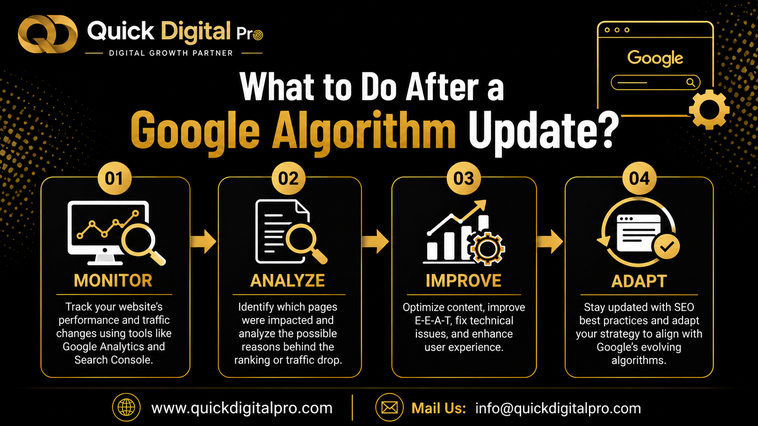
1. Check Whether the Update Has Finished
If Google has announced an update, first check its rollout status.
Rankings can fluctuate while an update is still rolling out. Google recommends confirming that a core update has finished before analyzing its impact. It also recommends waiting at least a full week after a core update has completed before making a detailed comparison in Search Console.
This helps you avoid reacting to temporary volatility.
2. Check Google Search Console
Google Search Console should be one of the first places you investigate when organic performance changes.
Compare your performance before and after the update.
Look at:
- Clicks
- Impressions
- Average position
- Search queries
- Top-performing pages
- Pages that lost visibility
Instead of saying, “My traffic dropped,” try to answer:
Which pages lost traffic?
Which search queries changed?
Did impressions fall, or only clicks?
Did rankings change across the whole website or only specific sections?
This gives you a much clearer starting point.
3. Compare the Current Search Results
Once you know which pages have lost visibility, search for the keywords that matter.
Look at the pages currently ranking above yours.
Ask:
- Are they answering the searcher’s question more clearly?
- Do they provide more useful information?
- Are they more specific to the search intent?
- Do they include original examples or useful data?
- Is their information more current?
- Do they demonstrate real experience or expertise?
The purpose is not to copy your competitors.
Instead, understand what the current search results are rewarding and identify where your own page can provide greater value.
4. Review Your Content
Your content should be created primarily to help people, not simply to attract search engine traffic.
Ask yourself:
Does this page satisfy the search intent?
Is the information accurate and current?
Does it provide something genuinely useful?
Does it demonstrate knowledge or experience?
Would a visitor feel satisfied after reading it?
Google’s guidance emphasizes creating people-first content that is useful and reliable rather than content created primarily to manipulate search rankings.
5. Check Your Technical SEO
Content is not the only thing worth investigating.
If you notice a significant change in organic visibility, review your website’s technical health as well.
Check:
- Indexing
- Crawling
- Broken links
- Redirects
- Canonical URLs
- Mobile usability
- Internal linking
- Page experience
- Important pages accidentally blocked from crawling or indexing
A ranking change that happens around the same time as an algorithm update does not necessarily mean the update caused it.
Website changes, technical problems, competitors, seasonality and normal search fluctuations can also affect organic performance.
6. Compare Different Time Periods
Don’t compare only yesterday with today.
Look at a longer period in Google Search Console to identify whether the change is temporary or part of a larger trend.
For example, compare:
- Before the update
- During the rollout
- After the rollout
- The same period from the previous year, where relevant
This gives you better context and reduces the risk of making decisions based on short-term fluctuations.
What Should Businesses Focus on in 2026?
I have seen businesses try to predict Google’s algorithm update but this does not give a sustainable SEO strategy.
Instead businesses should build websites that stay useful even as Google’s systems change.
Create People-First Content
Start with your audience than with the keyword.
Before creating a page understand what the user really wants to know, compare, buy or accomplish.
A page that genuinely solves a user’s problem is more valuable than a page that simply repeats a keyword throughout the content.
Demonstrate Experience and Expertise
Businesses should make it clear why visitors should trust the information that businesses publish.
Use information, real examples, relevant experience and clear business information.
Do not simply rewrite what dozens of websites have already published. Add your useful perspective, examples, processes, data or experience where appropriate.
Keep Important Content Updated
Content freshness does not mean changing the publication date every weeks.
It means updating information when something has genuinely changed.
For example an article aboutGoogle algorithm updates in 2026 should not continue presenting update information as though it were current.
Review pages periodically and update them when doing so improves accuracy or usefulness for readers.
Build Content Around Search Intent
A keyword alone does not tell you everything a user wants.
For example someone searching “Google algorithm update” may want to understand what an update is.
Someone searching “Google ranking dropped after update” is likely looking for troubleshooting steps.
Understanding this difference helps businesses create pages that answer the question behind the search.
Prepare for New Search Experiences
Google Search is also evolving alongside AI‑powered search experiences.
Google’s current guidance emphasizes unique, non‑commodity content and explains that established SEO fundamentals remain important for visibility across newer AI‑powered Search experiences.
That means businesses do not need to create a separate strategy, for every new search feature.
Instead build a foundation:
- Useful information
- Clear structure
- Original value
- Accurate content
- Strong technical SEO
- A good user experience
- Clear information about the business
What Should You NOT Do After a Google Algorithm Update?
A ranking drop can create pressure to make changes but reacting without understanding the problem can make ranking strategy less effective.
– Do not delete large amounts of content immediately. A ranking decline does not automatically mean every affected page is useless.
– Do not stuff keywords into pages. Repeating a keyword will not automatically restore rankings.
– Do not copy competitors blindly. A page ranking above ranking may have strengths that’re not obvious from word count or heading structure.
–Do not assume every traffic change is caused by Google. Investigate issues, seasonality, competitors and other possible causes.
– Do not chase every SEO trend. Build ranking strategy, around audience, business goals and actual website performance.
– Do not make dozens of changes at once. If ranking changes are made all at once it becomes much harder to determine what actually improved or hurt performance.
How Can You Build an SEO Strategy That Handles Algorithm Changes?
There is no way to guarantee that a website will never experience ranking fluctuations.
However, businesses can build a stronger foundation by focusing on the fundamentals.
Create useful content.
Understand search intent.
Maintain a technically healthy website.
Demonstrate genuine expertise.
Keep important information accurate.
Monitor organic performance.
Improve pages based on what users actually need.
The goal isn’t to “beat” Google’s next algorithm update.
The goal is to build a website that continues to provide value even as Google’s search systems change.
When SEO is treated as an ongoing process within a broader digital marketing strategy, businesses are better prepared to respond to ranking changes without making unnecessary decisions.
Frequently Asked Questions About Google Algorithm Updates
1.What is a Google algorithm update?
A Google algorithm update is a change to the systems Google uses to evaluate and rank content in its search results. Some changes are minor, while broader core and spam updates can cause noticeable changes in search visibility.
2.How often does Google update its algorithm?
Google makes many changes to Search throughout the year. Some are smaller changes that may not be publicly announced, while broader ranking updates such as core and spam updates can be officially recorded on Google’s Search Status Dashboard.
3.What is a Google core update?
A Google core update is a broader change to Google’s core ranking systems. These updates can change how Google evaluates pages and can result in ranking changes across many websites.
4.Can a Google algorithm update lower my website rankings?
Yes. A Google algorithm update can cause some pages to gain or lose visibility. However, a ranking decline does not automatically mean that your website has received a penalty.
5.What should I do if my website loses traffic after a Google update?
First, check whether the update has finished rolling out. Then review Google Search Console, identify the pages and queries affected, compare the current search results and review your content and technical SEO before making major changes.
6.How long should I wait before analyzing a Google core update?
Google recommends confirming that the update has finished and waiting at least a full week after a core update completes before analyzing your website’s performance in Search Console.
7.How can businesses protect their SEO from future Google updates?
No SEO strategy can completely prevent ranking changes. However, businesses can build a stronger foundation by creating useful content, satisfying search intent, maintaining good technical SEO, demonstrating expertise and continuously improving their website based on user needs.
Build a Stronger Digital Presence With Quick Digital Pro
Google Search will continue to evolve, but businesses don’t need to panic every time an algorithm update is announced.
A strong digital marketing strategy focuses on useful content, a technically healthy website, the right audience and long-term growth rather than chasing every ranking fluctuation.
Quick Digital Pro helps businesses build practical digital marketing strategies around their goals, audience and online presence.
If you’re looking to strengthen your website’s visibility and build a more effective digital marketing strategy, explore Quick Digital Pro and discover how your business can grow online.