
L
o
a
d
i
n
g

How AI Is Transforming Email Marketing Campaigns in 2026
30
Aug
How AI Is Transforming Email Marketing Campaigns in 2026
How AI Is Transforming Email Marketing Campaigns
Email marketing continues to be one of the most effective ways for businesses to connect with customers, nurture leads, promote products, and build long-term relationships. But in 2026, email marketing is becoming smarter than ever because of Artificial Intelligence (AI).
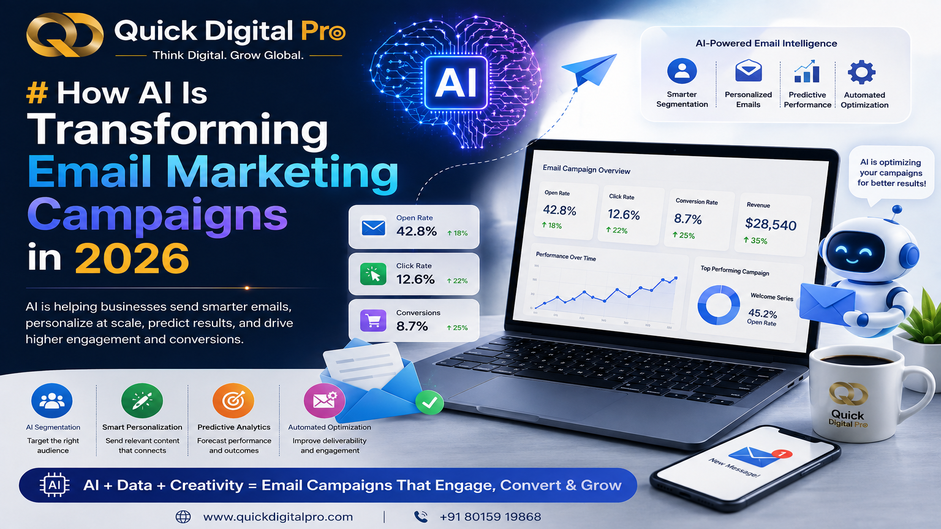
AI is transforming the way businesses create, personalize, send, analyze, and optimize email campaigns. Instead of sending the same message to every subscriber, marketers can use AI to understand customer behavior and deliver more relevant content at the right time.
For businesses exploring Email Marketing Company in Coimbatore, AI provides new opportunities to improve personalization, engagement, automation, and campaign performance. Quick Digital Pro can help businesses understand how AI-powered digital marketing strategies can be integrated into modern email campaigns.
What Is AI-Powered Email Marketing?
AI-powered email marketing uses artificial intelligence, machine learning, predictive analytics, natural language processing, and automation to improve email campaigns.
Traditional email marketing often requires marketers to manually create customer segments, write multiple email versions, choose sending times, and analyze campaign reports.
AI can automate or assist with many of these activities.
AI-powered email marketing can help businesses with:
- Customer segmentation
- Email personalization
- Subject-line generation
- Content creation
- Send-time optimization
- Customer behavior analysis
- Lead nurturing
- Campaign automation
- A/B testing
- Performance prediction
- Churn prediction
- Conversion analysis
The result is a more personalized and data-driven approach to email marketing.
AI Makes Email Personalization Smarter
Email personalization is no longer limited to mentioning a subscriber’s first name. In 2026, artificial intelligence enables marketers to create more relevant email experiences by analyzing factors such as customer behavior, interests, purchase history, website activity, previous interactions, and engagement trends.
For instance, an online fashion business can use AI to deliver different email content based on each customer’s preferences:
- Customer A: Special offers on men’s footwear
- Customer B: Updates on women’s fashion and latest collections
- Customer C: Notifications about new product arrivals
- Customer D: Product suggestions inspired by previous purchases
Rather than sending the same message to an entire subscriber list, businesses can use AI to identify customer segments and deliver content that matches their individual interests.
This level of personalization can help businesses improve engagement, build stronger customer relationships, and make Email Marketing Company in Coimbatore more effective when reaching diverse audiences.
AI Improves Email Segmentation
Audience segmentation is essential for effective email marketing.
Instead of dividing subscribers only by age or location, AI can identify behavioral patterns.
For example, AI may identify groups such as:
- Frequent buyers
- First-time customers
- Highly engaged subscribers
- Inactive subscribers
- Price-sensitive customers
- High-value customers
- Customers interested in specific products
- Subscribers who frequently click but rarely purchase
Businesses can then create campaigns specifically for each group.
This makes email communication more relevant and reduces the chances of sending irrelevant messages.reate different campaigns for new leads, repeat customers, inactive subscribers, and high-value customers.
AI Can Generate Email Content Faster
Developing fresh email content for every marketing campaign can be a time-consuming task. With AI-powered writing tools, marketers can speed up the initial content creation process and generate draft ideas for various types of campaigns, including:
- Promotional campaigns
- Welcome and onboarding emails
- Email newsletters
- New product announcements
- Abandoned-cart reminders
- Invitations to events and webinars
- Customer follow-up messages
- Educational email series
- Customer loyalty and retention campaigns
While AI can make content creation faster, marketers should avoid publishing AI-generated copy without reviewing and refining it. Human input is still essential for maintaining the brand’s tone, checking facts, understanding customer expectations, and making sure every email offers genuine value.
A practical approach for modern email marketing is:
AI for faster content creation + Human expertise for authenticity and quality.
AI Predicts the Best Time to Send Emails
Sending an email at the wrong time can reduce engagement.
AI can analyze individual subscriber behavior to identify when users are more likely to open, click, or interact with emails.
Instead of sending every email to everyone at the same time, businesses can use AI-powered send-time optimization to improve the timing of campaigns.
For example, one subscriber may frequently engage with emails during the morning, while another may be more active in the evening.
AI can help marketers move toward more individualized delivery times.
AI Helps Predict Customer Behavior
Predictive analytics is becoming increasingly important in email marketing.
AI can analyze historical behavior to identify potential future actions.
For example, AI may help identify customers who are:
- Likely to purchase
- Likely to stop engaging
- Interested in a particular product
- Ready for an upgrade
- Likely to respond to an offer
- At risk of becoming inactive
Marketers can then create campaigns based on these predictions.
For example, an inactive customer could receive a re-engagement email, while a highly engaged customer could receive an exclusive offer.
AI Improves Email Automation
Email automation is one of the biggest benefits of AI-powered marketing.
Businesses can create automated customer journeys based on actions and behaviors.
A simple automated journey could look like:
Website Visit → Signup → Welcome Email → Content Email → Product Recommendation → Follow-Up → Offer
AI can make these journeys more dynamic by analyzing customer behavior and adjusting future communications.
For example, if a subscriber clicks on a product category several times but does not purchase, the system could trigger a relevant follow-up campaign.
AI Helps Improve Email Deliverability
Getting an email into the inbox is just as important as creating the email.
AI can help marketers monitor campaign signals and identify potential deliverability issues.
It can analyze patterns related to:
- Engagement
- Bounces
- Unsubscribes
- Spam complaints
- Inactive subscribers
- Sending frequency
This information can help businesses maintain healthier email lists and improve their overall email strategy.
Businesses should still follow email regulations, permission requirements, authentication standards, and the policies of their email service provider. email campaigns before customer engagement declines.
AI Helps Reduce Customer Churn
Subscribers may stop engaging with emails for many reasons.
AI can identify signs of declining engagement, such as:
- Fewer opens
- Fewer clicks
- Longer periods of inactivity
- Repeated ignored emails
Businesses can then create re-engagement campaigns.
A re-engagement strategy could include:
“Still interested?”
followed by personalized content, a preference-management option, or a relevant offer.
If subscribers genuinely no longer want emails, businesses should make unsubscribing easy rather than repeatedly sending unwanted messages.
AI Improves Email Marketing Analytics
Email campaigns produce a significant amount of performance data, and AI can help marketers turn that data into useful business insights. Instead of reviewing each metric separately, AI-powered analytics can examine multiple data points and uncover patterns in customer behavior.
It can evaluate factors such as:
- Email open rates
- Click-through activity
- Conversion performance
- Sales and revenue
- Unsubscribe rates
- Bounce rates
- Overall engagement
- Customer lifetime value
AI can go beyond showing numbers by identifying relationships and trends across multiple campaigns.
For example, an AI-powered analysis might reveal that customers who regularly interact with educational content have a higher likelihood of making a purchase later.
These insights allow marketers to understand what content resonates with their audience, refine future campaigns, and develop a more effective long-term email marketing strategy.
AI and Email Marketing for Local Businesses
AI-powered email marketing is not only useful for large companies.
Local businesses can also use it to build stronger customer relationships.
Businesses in Coimbatore can use email campaigns for:
- Local offers
- New product announcements
- Event promotions
- Customer loyalty programs
- Appointment reminders
- Educational newsletters
- Seasonal campaigns
- Re-engagement campaigns
For example, a Coimbatore-based retail store could segment customers based on previous purchases and send personalized product recommendations.
Similarly, an educational institution could send different email sequences to students, parents, and prospective learners.
This makes Email Marketing Coimbatore in Coimbatore a useful strategy for both local and growing businesses.
Conclusion
AI is transforming email marketing campaigns in 2026 by making them more personalized, automated, predictive, and data-driven.
From generating subject lines and email content to segmenting audiences, predicting customer behavior, optimizing send times, improving automation, and analyzing campaign performance, AI can support almost every stage of email marketing.
But AI should not be used simply to send more emails.
The real opportunity is to send better emails to the right people at the right time with the right message.
Businesses that combine AI technology with human creativity, responsible data practices, and genuine customer value can build stronger email marketing campaigns in 2026.
For companies looking to strengthen their online presence through Email Marketing Company in Coimbatore, adopting an AI-powered approach can be an important step toward smarter customer engagement and sustainable digital growth.
Frequently Asked Questions (FAQ)
1. How is AI transforming email marketing?
AI is transforming email marketing through intelligent personalization, audience segmentation, content generation, automation, predictive analytics, send-time optimization, and campaign performance analysis.
2. Can AI create email marketing content?
Yes. Generative AI can help create email drafts, subject lines, headlines, CTAs, content ideas, and different versions of campaigns. Human review is recommended before publishing.
3. How does AI personalize email campaigns?
AI can analyze customer behavior, interests, previous purchases, website activity, and email interactions to help deliver more relevant content and product recommendations.
4. Is AI email marketing suitable for small businesses?
Yes. Small businesses can use AI for customer segmentation, automated email sequences, content assistance, personalization, and campaign analysis without needing to perform every task manually.
5. Can AI help generate leads through email marketing?
Yes. AI can support lead generation by helping businesses identify customer interests, personalize communication, automate lead nurturing, and determine which leads are showing stronger engagement.
6. Will AI replace email marketers?
No. AI is better viewed as a tool that supports marketers. Human strategy, creativity, brand understanding, customer empathy, and decision-making remain important.
7. What is the future of AI in email marketing?
AI-powered email marketing is likely to become more personalized, predictive, automated, and behavior-driven. Businesses will increasingly use AI to deliver relevant messages based on individual customer needs and interactions.